

Enforcement
Enforcement
FINRA’s mission is to protect investors and safeguard market integrity to ensure that everyone can invest in the securities markets with confidence. To support this work, FINRA Enforcement reviews potential misconduct and, where necessary, brings disciplinary actions against FINRA member firms and their associated persons. Enforcement actions look to address violations, deter future misconduct and, where possible, obtain restitution for harmed customers.
Enforcement Priorities
While we receive a wide range of referrals from our colleagues in FINRA’s Regulatory Operations and other parts of FINRA, and take action across the full spectrum of violations, we prioritize matters that have the greatest impact on investors and markets, including those:
- involving investor harm, particularly to seniors and other vulnerable investors;
- where there has been harm to the integrity of the markets;
- where the conduct may not yet have resulted in quantifiable harm but nonetheless created significant risks to investors or markets;
- involving recidivist behavior, including repeat violations that were previously addressed with informal discipline;
- involving firms and brokers with a history of misconduct; and
- involving financial or operational risk.
Who We Are
FINRA Enforcement sits within FINRA’s unified Regulatory Operations, which brings together specialized groups as a unified team to examine firms, conduct surveillance, review analytics, investigate potential securities violations and, when necessary, bring disciplinary action. Enforcement staff attorneys are assigned to groups that report to a director, who in turn reports to a chief counsel. Each of the chief counsel teams consists of directors leading teams of attorneys. The chief counsel groups all work on a range of cases, while maintaining expertise in a few assigned specialization areas. The chief counsel teams are aligned to 11 specialization areas that generally mirror specialized teams in other FINRA departments or that look to cover potentially complex issues that arise frequently, including anti-money laundering (AML), SEC Regulation Best Interest (Reg BI), market issues, variable annuities and financial responsibility-related concerns. Complex matters that fall within a specialization area are handled by the designated Enforcement teams to leverage expertise, foster better collaboration and create opportunities for greater efficiency.
We also have experienced trial lawyers who review matters to ensure that sufficient evidence exists to proceed to litigation and support the chief counsel groups during the hearing process when a formal disciplinary action does not result in settlement.
Two senior vice presidents, who report to the Head of Enforcement, oversee the chief counsel groups. Another team within Enforcement, the Enforcement Consult Group, separately works to enhance the consistency and clarity of Enforcement settlement documents by reviewing certain designated matters.
What We Do
FINRA relies on comprehensive procedures and management oversight to guide the Enforcement process. Enforcement considers matters without bias for or against the firms or associated persons involved. To preserve the integrity and fairness of the inquiry, FINRA treats all investigations as non-public and confidential. This overview focuses on FINRA-only matters and does not cover matters FINRA handles on behalf of an exchange.
FINRA investigations are opened based on information from various sources, including automated surveillance reports, examination findings, filings or reports made with FINRA, customer complaints, anonymous tips or referrals from other regulators. Most matters referred to Enforcement originate with other FINRA Regulatory Operations Departments – including Examinations, Investigations and Surveillance – as well as other FINRA areas such as Advertising Regulation and Corporate Financing. These groups review available information and conduct fact finding. This can include requesting documents and information pursuant to FINRA Rule 8210 (Information and Testimony Requests) or otherwise and contacting customers or other individuals or entities who may agree to provide information voluntarily.
Enforcement attorneys may assist at any stage of an investigation or examination and are always involved in the taking of testimony. They also review documents and information to provide advice based on their knowledge of applicable securities laws and rules. The involvement of Enforcement personnel does not mean that a determination has been made about the outcome of a matter. Often, Enforcement staff can help contribute to an early decision to resolve a matter with no action or informal disciplinary action.
Before a formal referral to Enforcement, a matter may be closed with no further action, result in a Cautionary Action Letter or be referred to another regulator for further review.
FINRA Enforcement Process - Pre-Referral
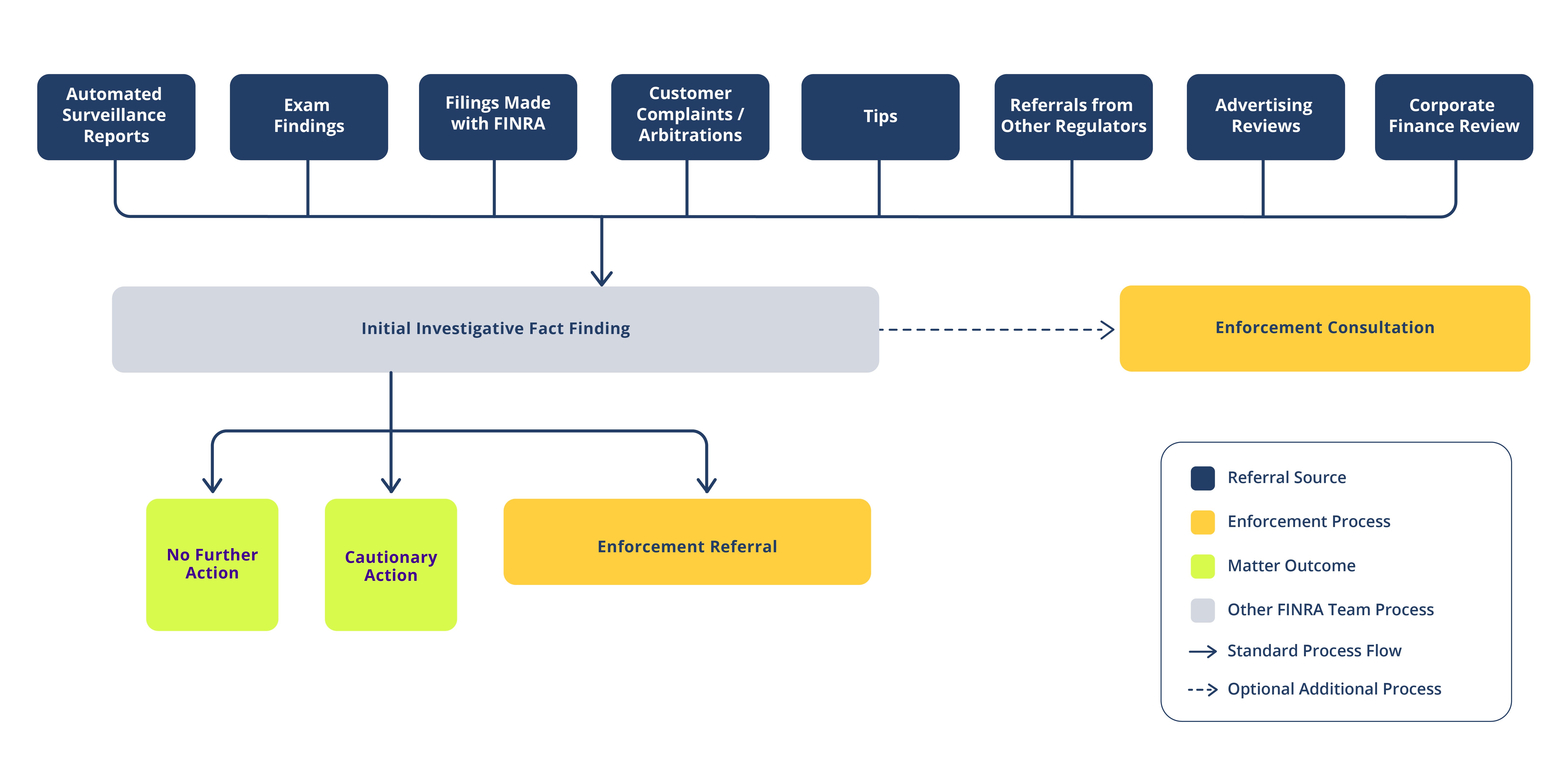
Shortly after Enforcement receives a referral, it sends a letter to the potential respondent firm or associated person (or their attorney, if they are represented) to notify them of the referral. This letter provides contact information for the Enforcement attorney assigned to the matter and their manager who can also serve as points of contact for the firm or associated person. Where the respondent is a member firm, the letter also informs the firm of the option of having an introductory meeting, during which Enforcement will provide the subject of the referral, an overview of the Enforcement process and answer the firm and/or counsel’s questions.
FINRA Enforcement Process - Post-Referral
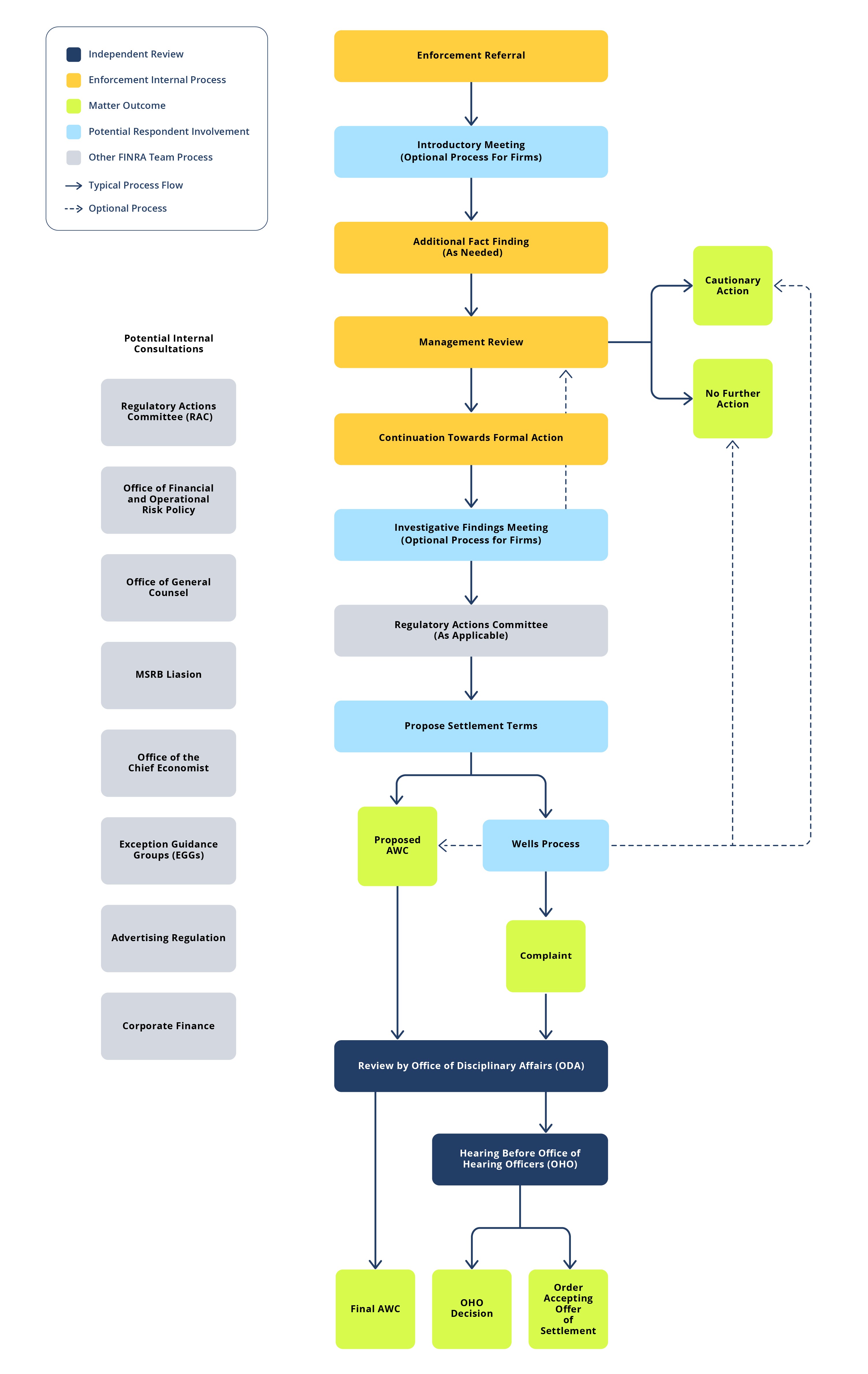
While not required, firms and associated persons may retain an attorney to represent them at any point during the lifecycle of a matter.
Enforcement updates firms and associated persons periodically during this process to let them know the status of the matter, particularly during periods when there has been no other contact or apparent activity. Firms and associated persons are encouraged to contact Enforcement staff at any time if they have questions about the status of a matter.
When Enforcement’s review of a matter is largely complete and it relates to a member firm, Enforcement staff will offer to schedule an optional meeting with the member firm to discuss the factual findings of the investigation, including a description of the evidence that the staff relied upon to draw their findings. This meeting provides an opportunity for the firm to augment, clarify or dispute FINRA’s factual understanding of a matter and offer any additional information the firm believes FINRA should consider prior to making any charging, outcome and sanctions recommendations.
Potential Outcomes
At the end of this fact-finding process, the Enforcement staff assesses the facts in conjunction with the applicable securities laws and rules to make a disposition recommendation. This assessment is conducted under the supervision of the director and chief counsel responsible for the matter.
The Enforcement attorney may recommend no further action, informal disciplinary action or formal disciplinary action. A single matter may result in more than one type of outcome if the matter includes multiple issues. The Enforcement attorney considers all relevant facts in making this recommendation, including any facts that may suggest that no further action or informal disciplinary action is the appropriate outcome.
In certain matters, Enforcement brings disposition and sanction recommendations to FINRA’s Regulatory Actions Committee (RAC) for discussion. This group consists of senior leaders across Regulatory Operations and FINRA more broadly, including FINRA’s Chief Legal Officer. The RAC discusses novel regulatory issues and noteworthy potential Enforcement matters.
No Further Action
Not all matters result in disciplinary action. Staff may determine not to recommend disciplinary action based on the information they received and reviewed. In such cases, firms and individuals will receive a letter notifying them that the matter has been closed without further action. A significant number of FINRA Enforcement’s matters each year result in no further action.
Informal Disciplinary Action
Matters may be resolved through informal disciplinary action with the issuance of a Cautionary Action Letter when staff concludes that a violation occurred, but the misconduct does not merit formal disciplinary action. Informal disciplinary action may be appropriate when there is an absence of customer harm or detrimental market impact. Informal disciplinary action likewise may be appropriate where harmed customers have been made whole. It also may be appropriate if a firm or associated person has demonstrated substantial cooperation in FINRA’s investigation or proactively remediated the issue. Before issuing a Cautionary Action Letter, Enforcement generally provides the prospective recipient with a chance to preview the prospective findings.
The Cautionary Action Letter briefly describes the misconduct at issue, identifies the applicable securities laws, regulations or rules violated and may identify corrective action taken by the firm or individual. Although informal disciplinary actions can be considered by FINRA in any future examination, investigation or disciplinary action, they do not constitute formal discipline and are not reportable on Form U4, Form U5, Form BD or BrokerCheck®.
Formal Disciplinary Action
FINRA can take formal disciplinary action through two separate procedures:
Negotiated Settlement
If Enforcement determines that formal disciplinary action is appropriate, it will make a settlement offer to the firm or associated person or their attorney. This offer will describe FINRA’s factual findings and identify the rule violations that would be charged along with the proposed sanctions, which draw on FINRA’s public Sanction Guidelines. Enforcement managers review such offers, with other subject matter experts across the organization often providing counsel on the charges.
The firm or associated person can reject a settlement offer from Enforcement, agree to the offer or respond with a counteroffer to the charges, the sanctions or both. If Enforcement and the respondent agree in principle to the settlement terms, Enforcement will send a draft settlement document called a Letter of Acceptance, Waiver and Consent (AWC). The AWC sets forth the terms of the settlement, including FINRA’s factual findings, a description of the rules or laws violated, the sanctions to be imposed and other legal aspects of the settlement. The AWC also may discuss other aspects of the matter including, where appropriate, credit for cooperation and proactive remediation or other factors that Enforcement considered in determining the appropriate sanction.
During settlement negotiations, the firm or associated person may propose alternate AWC language describing the respondent and violations, which Enforcement staff will consider. If the firm or associated person agrees to the language of the AWC—which means that they accept and consent to FINRA’s findings (without admitting or denying them) and consent to the imposition of the sanctions described in the AWC—they execute the document. Enforcement then submits the AWC and any Statement of Corrective Action1 or Mitigation Statement2 from the respondent to the Office of Disciplinary Affairs (ODA) for approval.
ODA is a separate, independent office within FINRA and is not part of Enforcement. It is not involved in the investigation, settlement or litigation of matters. ODA conducts an independent review of each proposed settlement and sanctions to promote fairness and consistency in FINRA disciplinary actions. If ODA approves the settlement, Enforcement will issue the AWC as a formal disciplinary action.
After Enforcement sends the AWC to the firm or associated person, the AWC is posted on FINRA Disciplinary Actions Online, which is a searchable database that makes FINRA’s disciplinary actions accessible via its website. Information about the AWC will also be added to FINRA’s Central Registration Depository (CRD) system, made available on BrokerCheck® and included in FINRA’s monthly disciplinary actions report.
1A Corrective Action Statement describes the demonstrable steps taken to correct a violation and is attached to a final AWC.
2A Mitigation Statement describes the mitigating circumstances for consideration by the Department of Enforcement and ODA in determining whether to accept the AWC but is not attached to the AWC or made publicly available.
Wells Process
When a matter is not able to be resolved through settlement negotiations, absent limited circumstances, Enforcement staff will call to inform the firm, associated person or their attorney of the proposed charges and provide an overview of the evidence that supports those charges. This is generally referred to as a Wells Call. The Wells call is followed by a letter confirming the call and identifying the proposed charges. The purpose of the Wells process is to give the firm or associated person an opportunity to submit a response to address the facts and applicable laws and explain why Enforcement should not pursue formal charges. Meetings with potential respondents to discuss the submission is common at this stage. Enforcement considers those submissions in evaluating whether to go forward with a formal action. Enforcement includes all Wells responses when submitting an AWC or complaint to ODA for review.
Litigated Proceeding
If Enforcement and a firm or an associated person don’t agree to a settlement, and Enforcement continues to believe that a formal action is appropriate, Enforcement will submit a disciplinary complaint to ODA for approval to file with FINRA’s independent Office of Hearing Officers (OHO). OHO is an office of impartial adjudicators that maintains strict independence from FINRA’s regulatory programs.
If ODA approves the complaint, Enforcement serves it on all respondents and files it with OHO, which makes the complaint public through the same channels as a finalized AWC. After a complaint has been filed, the firm or associated person can settle the matter through an Offer of Settlement.
Unless the respondent settles the complaint, the matter will proceed to a contested hearing before OHO. Firms and associated persons may be represented by counsel in disciplinary proceedings. FINRA is represented by staff from Enforcement, including litigation attorneys.
FINRA’s disciplinary hearing process is governed by the 9200 Series of FINRA’s Code of Procedure, which ensures that hearings are conducted in a fair manner, hearing panels act impartially and objectively, and cases are concluded as quickly as possible. A hearing panel determines whether the firm or associated person committed the violations alleged by Enforcement and, if so, imposes any sanctions, which are included in a written decision that is then made public.
Appeals are made to the National Adjudicatory Council (NAC), which can also call OHO hearing panel decisions for review even if no party files a notice of appeal of the decision. Further appeals are made to the Securities and Exchange Commission and then the United States Court of Appeals.
Potential Sanctions
FINRA determines appropriate sanctions, drawing on the FINRA Sanction Guidelines. The Sanction Guidelines recommend ranges for sanctions for typical violations and suggest factors to consider in determining sanctions within, above or below that range. Enforcement will also consider the aggravating and mitigating factors detailed in the Principal Considerations in Determining Sanctions section of the Sanction Guidelines.
Sanctions may include fines, restitution, disgorgement, suspensions and undertakings designed to remediate the root cause of the misconduct. When customers are harmed, restitution is our top priority. In fact, FINRA sometimes brings cases where the only monetary sanction is restitution. In matters involving the most serious misconduct, Enforcement may seek bars and expulsions from FINRA membership.
Resources
This free tool provides information about FINRA-registered firms and individuals. It includes information about customer complaints, arbitrations and civil litigation.
This database contains all FINRA disciplinary actions from 2005 onward, including related decisions from the SEC and federal appellate courts.
These monthly reports provide a summary of all new formal disciplinary actions against firms and individuals.
Developed by the National Adjudicatory Council (NAC), these guidelines are used to determine appropriate remedial sanctions in FINRA disciplinary actions.
FINRA publishes Regulatory Notices to provide firms with timely information on a variety of issues.
These monthly reports provide a summary of all new formal disciplinary actions against firms and individuals.