
PODCAST
Investors in the United States: Key Trends and Insights from the National Financial Capability Study
The FINRA Investor Education Foundation’s National Financial Capability Study is an expansive source of data and insights about the financial lives of U.S. adults. Conducted every three years, this wide-ranging research effort includes the Investor Survey, an in-depth exploration of the attitudes, behaviors, knowledge and experiences of retail investors across the country.
In December, the FINRA Foundation published the latest iteration of the survey, titled "Investors in the United States: Results from the FINRA Foundation’s National Financial Capability Study." Drawing on responses from nearly 3,000 respondents in the U.S. with non-retirement investment accounts, the latest edition builds on previous Investor Survey reports, conducted every three years since 2015.
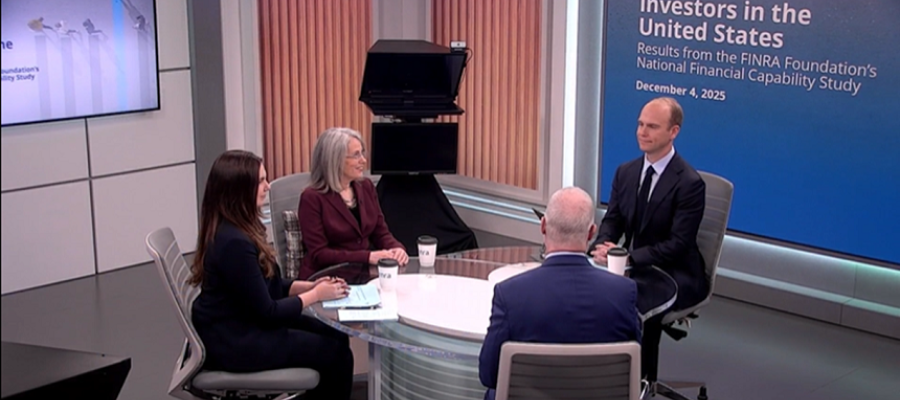
On this episode of FINRA Unscripted, FINRA Foundation President Gerri Walsh, the Foundation's Research Director Gary Mottola, and Senior Researcher Olivia Valdes discuss the study's wide-ranging findings and implications.
Resources mentioned in this episode:
The National Financial Capability Study (NFCS)
Investors in the United States A Report of the National Financial Capability Study
Ep. 176: National Financial Capability Study: Key Trends and Insights
2026 FINRA Annual Regulatory Oversight Report
Listen and subscribe to our podcast on Apple Podcasts, Google Podcasts, Spotify,YouTube or wherever you listen to your podcasts. Below is a transcript of the episode. Transcripts are generated using a combination of speech recognition software and human editors and may contain errors. Please check the corresponding audio before quoting in print.
FULL TRANSCRIPT
00:00 – 01:34
Joe Atmonavage: The FINRA Investor Education Foundation’s National Financial Capability Study is an expansive source of data and insights about the financial lives of U.S. adults. Conducted every three years, this wide-ranging research effort includes the Investor Survey, an in-depth exploration of the attitudes, behaviors, knowledge and experiences of retail investors across the country.
In December, the FINRA Foundation published the latest iteration of the survey, titled Investors in the United States: Results from the FINRA Foundation’s National Financial Capability Study. Drawing on responses from nearly 3,000 respondents in the U.S. with non-retirement investment accounts, the latest edition builds on previous Investor Survey reports, which are conducted every three years since 2015.
Welcome to FINRA Unscripted. I'm your host, Joe Atmonavage, and today’s episode features a comprehensive discussion of the report with FINRA Foundation President Gerri Walsh, The Foundation's research director, Gary Mottola, and senior researcher Olivia Valdes.
The three detailed the findings around new investors entering the markets, behaviors of young investors, investor knowledge gaps, cryptocurrency interest and much more. This discussion was originally part of a virtual press conference held for the media in December.
And now here is that conversation.
01:35 - 01:42
Joe Atmonavage: Gary, I want to start with you. We heard about some things that could be maybe a little concerning. What was encouraging about the report and the findings?
01:43 - 02:26
Gary Mottola: One encouraging finding that jumped out at us was related to the motivation people have for investing. So we asked people to list the reasons that they started investing and across the board, the number one reason for all age groups is that long term gains. Their investing for the long term and they want to make money in the long term, which is good.
But when you look at the younger adults, it's interesting because the second most cited reason among younger adults is to learn about investing. And we find this to be encouraging for a number of reasons. One, they see the value in investing. They see the importance in increasing their knowledge and potentially increasing the returns and what they can get out of investing in the capital markets.
These are all encouraging things. And that was certainly one thing that jumped out at us right from the start.
02:27 – 02:42
Joe Atmonavage: Thanks for that, Gary. Gerri, you know, people have the easier access to retail investing than ever before, there's content at their fingertips constantly. Was it surprising that fewer adults are owning investments in 2024 from this report?
02:43 – 04:27
Gerri Walsh: So access is one factor for sure. But it's not the only factor. And there were factors that were really unique to the 2021 wave. At that time, a number of people had Covid stimulus payments that gave them additional cash. Some of them might have been getting unemployment compensation. It was really, truly a different world.
And especially in 2020, early part of 2021, when things still felt locked down, people were motivated by different things than Gary reported just now. People were more likely to be motivated by the social aspect and engaging in investing that way. So while we do see, especially among younger and newer investors, there's a higher use of app based platforms for investing.
That isn't the only factor. It's really difficult when people are struggling in the now to be able to focus on even short term goals, let alone long term goals, which is the primary motivation for investing. And we do know from the National Financial Capability Study, state-by-state survey that was released in July that more people now are struggling than had been previously.
But those demographic shifts are really interesting. While overall the level of investing declined by 1%, it's still higher than it was in 2018 and 2015. And while there have been steep declines in some demographic groups, especially that younger cohort, which declined by six percentage points.
When you look back to 2015 and 2018, there is a more kind of positive story of the markets are increasingly more open to more people.
04:28 – 04:56
Joe Atmonavage: Absolutely. Thanks for sharing that, Gerri. And you mentioned young investors. Olivia, that was definitely a theme, throughout your presentation. So let's talk about those young people. They reported that they were willing less willing to take risks than the previous wave. Yet we see younger investors are more likely to be trading options, trading on margin, interested in crypto.
What stands out about those findings. And then is this a case of investors saying one thing, taking less risk, but doing another, maybe investing in things that could potentially carry greater risk. So how do we make sense of that?
04:57 – 06:39
Olivia Valdes: This this is a really interesting issue and something that I think gets at a lot of what we're seeing. On the one hand we do see that investors, especially young investors, are much less willing to take those high levels of risk. That fell by nine percentage points. Yet, we do see that they are invested in things that can carry higher risk.
So 43% of those 18 to 34, they are trading options. 22% are purchasing on margin. Half of them are invested in crypto. So yes, that is completely true. But I don't think it's necessarily the case of investors saying one thing and doing another. I think this might be an issue related to fundamental knowledge gaps. So we do see that in the youngest population of investors there are big knowledge gaps in terms of investing knowledge. Fewer than 1 in 10 are able to answer eight, at least eight of those 11 questions correct. So very, very, very few young investors are getting those investing questions correct. And so that might be part of what's happening. We also see that these individuals, the ones who are specifically invested in things that are arguably riskier. So people who are purchasing on margin, for instance, we have a question in the investing quiz about buying on margin. And 75% of those margin traders are not getting that margin question correct. So that, I think, is part of what's happening.
06:41 – 06:53
Joe Atmonavage: That's really interesting. So we're getting questions about the decline in young investors participating in the market. Gerri, I want to ask you, what do you attribute that decline to? Is there any backlash to maybe the meme stock frenzy that we had seen in recent years?
06:54 – 07:30
Gerri Walsh: Well, the data don't tell us the why necessarily. But they do show us the trends. And what we see from the National Financial Capability Study overall is that younger people in particular are struggling. They're struggling to make ends meet. So all of that tie back data that I had talked about that you can do to sort of see where people are.
We know that younger people are having a tougher time. And so that may well be a strong factor in why fewer investors, who joined the market, especially during the meme stock frenzy, are investing.
07:31 – 07:43
Joe Atmonavage: And yeah, this report obviously gives us a really good understanding and better idea of what's going on in the markets. What steps you feel like policymakers or industry members can take to maybe reverse that trend of the downturn of new investors and younger investors.
07:44 – 08:53
Gerri Walsh: There are a lot of policy steps that can be taken. I think continuing to have open markets, which is something that FINRA focuses on, in its mission. We focus on investor protection and market integrity, capital formation. So making markets open and available to all and keeping them free and fair, is also really important.
But understanding the importance of education and thinking about how, this is especially important for industry because industry plays such a huge role, as we saw from the statistics that Olivia cited. The industry is a very important educator. And so making sure that information is available, trustworthy, unbiased information, that can help slow down the decision making.
When there's less friction, it's a lot easier to make a quick decision. But not all quick decisions are good decisions. And so taking the time to think about your risk profile is really important. And if our educational messages, and our marketing messages talk about that. That can be, I think, an important factor in making sure that younger people feel like they can be in the market.
08:54 – 09:02
Joe Atmonavage: We got a question about motivation. Olivia, I want to turn to you. Do people's motivations to invest vary across age groups and experience levels, and if so, how does that?
09:03 – 10:18
Olivia Valdes: So like Gary mentioned earlier, the most popular motivation across the age spectrum, across different experience levels, is investing for long term financial gains. That's the first thing I'll say. That's a universal truth. Everybody has that same motivation. Where the variations lie is that these younger investors, these less experienced investors, they have other motivations as well.
So we are seeing that they're not just motivated by long term gains. They are motivated by short term gains. Many of them, more than 8 in 10 young investors, similar rates for less experienced investors. Many of them are investing because they want to learn more. A huge amount of young investors, less experienced investors, cite that. We also see that half or even a little bit more than half say things like, you know, I'm investing for entertainment. I'm investing for things like a social activity. So the reasons why people invest in that younger, less experienced side, they're just more reasons.
10:21 – 10:40
Joe Atmonavage: Thanks for sharing that. Olivia. Gerri, we're getting questions about young investors. Young investors are much more likely to get their information from social media. Olivia walks us through that in her presentation and rely on for influencers. Is this a good thing or is this a bad thing? And how concerned are you about people, especially young adults, getting their financial information from social media and/or if influencers.
10:41 – 11:18
Gerri Walsh: So is it good or bad? It's both. There's a lot of good information on social media. There's a lot of bad information on social media. And what's really important is that people understand how to distinguish good information from bad information. And, not in this study, but in a prior study, the Foundation explored that, and we saw that people weren't confident in their ability to distinguish the good from the bad. So I think we, as regulators, our colleagues in industry and policymakers need to be focused on thinking about how to help people distinguish good information from bad. But that's really the key.
11:19 – 11:31
Joe Atmonavage: Gary, I want to turn to you because young people are interacting with influencers. That's clearly been laid out in this report. What are the red flags that investors should be looking for when potentially getting recommendations from finfluencers.
11:32 – 12:52
Gary Mottola: First let me say that people should be aware of the red flags, but it's not just about finfluencers and social media. Investment fraud can come from any source. So you need to apply these red flags broadly, whoever you're interacting with, whatever information sources. The key red flags.
And it's encapsulated in the question that Olivia showed that half the people said they would invest in a somewhat questionable Investment. Essentially the three things we kind of really focus on is: are you being promised guaranteed or risk-free returns? Red flag number one, because we know that investing is not risk free. That's going to jump out right away.
Promised returns that are very, very high. That's something you need to look out for. But this is a little tricky because investors need to know what a very high return is, right? So part of part of educating investors is to let them know what types of returns they can expect from the various asset classes.
And the last one is consistently high returns. So not only are we promising you a 25% return, we're promising this over five years, right? It's hard to beat the market. It's very, very, very hard to beat the market consistently over a long period of time. Those are the big three.
There's some other investing fraud knowledge information people should know about. But I'll just say in a world where fraud victimization is increasing, it's just it's driving home the point that we really need to educate investors about what to look for when they are being offered potentially fraudulent investments.
12:53 – 13:33
Gerri Walsh: One other thing that people should be looking for is whether the individual that's offering this opportunity or the firm, whether it's registered with FINRA, with the Securities and Exchange Commission or a state regulator, because most of the fraud that happens, happens outside the realm of regulation, and especially if people are getting their information from social media, you know, there might be people who don't see themselves as investors who are getting information from social media.
They might not know about regulators, but they need to because you need to check BrokercCheck. You need to use the tools that are available to find out whether someone is licensed, and then use the SEC's Edgar system to find out whether the product is registered.
13:34 – 14:11
Olivia Valdes: I was just going to add that Gary's point and yours as well, Gerri, this is beyond finfluencers. Because we see that 50% of investors across the board are unable to detect the signs of investment fraud. But I will say, like specific to finfluencers, we cut the data where we looked at those people who use finfluencers, over 70% of them are unable to detect those red flags of fraud. And so this might be a population that we should really make sure that we are educating and reaching out to.
14:12 – 14:19
Joe Atmonavage: Absolutely. Gerri, I want to turn to you for this question that we received. Why do you think younger people are so much more concerned about fraud than older investors?
14:20 – 15:20
Gerri Walsh: When you look at the Federal Trade Commissions data on financial fraud, you do see that myth of fraud only happens with the little old lady living alone on limited means just isn't true. By far, younger populations are more targeted with a wide array of financial frauds, whether it's the IRS tax scam or any other kind of fraud, the HOV toll fee.
I think given that younger people are digital natives, they're more likely to be on their phone more often. They're more likely to just be pummeled with these messages, whether it's on social media platforms, communications platforms or they're seeing it in their text threads.
And so that is something that we need to remember. We know, that older people are more likely to lose more money. But younger people just broadly across the financial spectrum are more targeted and do get in trouble more with financial fraud offerings.
15:21 – 15:30
Joe Atmonavage: Absolutely. Thank you for sharing that, Gerri. And sticking with you. We got a question about for finfluencers again. We briefly touched on this, but how would you rate the quality of information that influencers are putting out there?
15:31 – 16:04
Gerri Walsh: Oh my goodness. I have not had the opportunity to review every single finfluencer who's out there. And the truth is that finfluence can come in strange corners. It can come in the health and beauty corner. It can come from hiking club corners. So I am not equipped to do that. I can say that FINRA has taken a look at the use of finfluencers by its member firms. And there's some great guidance that has come out about that. So I will leave it at that and encourage people to look at FINRA's key topic page on social media.
16:07 – 16:16
Joe Atmonavage: That's always a good resource. Thanks for sharing that, Gerri. Gary, I want to turn to you. There was so much emphasis on investing for retirement, long term planning. What should we make of the decline in non-retirement investing that we saw in this wave?
16:19 – 17:00
Gary Mottola: In some ways I think it comes down to a point Gerri made, which is that people are squeezed now more than they were in the past. And I think that's going to impact their ability to invest. There was a drop and it was encouraging when we saw the trend increasing.
But it is a small drop. And as Gerri put it, we're higher than we were in 2015. So, I think there are a number of factors, including the pandemic when people had more time and they had potentially stimulus money and things like that. A lot of the factors that that were pertinent back then aren't as pertinent right now.
I think it's good that we do this study, periodically because conditions are going to change and we may see that uptick continue it. There are a lot of there's still a lot of factors that can bring people into the markets. And maybe we'll see more of that the next time we go out and survey people.
17:01 – 17:12
Joe Atmonavage: Thanks. I'm surprised it took us this long, but we got a question cryptocurrency. So Gerri, I want to ask you: was it surprising to see that crypto interest has dropped based on the findings from this report? And why do you think that is?
17:15 – 18:07
Gerri Walsh: Yeah, so with respect to the drop, one of the interesting things is that the number of people who are invested has held very steady. So it's really just that gauge of interest and the gauge of interest does seem more aligned with 2018. So it seems like it's a return to a norm. You know, when it comes to crypto, a lot changes day to day and there have been changes even since we fielded the report.
And crypto, I think it's still a teenager, a young teenager, in terms of how long crypto assets have been available for people to consider. But it does show more volatility than the equity markets, for example. So, we do see that people who knew about cryptocurrency were expressing a lower level of interest compared with 2021, but pretty much on par, with 2018. And people do now see it as a more risky asset.
18:08 – 18:36
Olivia Valdes: It is completely accurate that people invested in crypto that has held steady across age groups, across a bunch of different demographics, except experienced investing. So those people who have less than two years experience, they drop pretty dramatically. And I think that has to do with, just the population that we've seen exiting the market that might be associated with that, but that there's one group where we did see that drop, which was curious.
18:37 – 18:58
Gerri Walsh: There was actually a higher level of investing among the 35- to 54-year-old crowd. I think it was three percentage points higher. And, correct me if I'm wrong, and it was equally an uptick of crypto acceptance, crypto investing among the 55-plus. Those are all interesting stats that I think industry and regulators should know about.
19:01 – 19:15
Joe Atmonavage: Absolutely. Olivia, I want to go back to kind of where people are getting their financial information from. You showed us a chart that had a lot of different sources. So why is it important that, you know, the various stakeholders, financial professionals, educators understand where these investors are going through that financial information?
19:15 – 20:28
Olivia Valdes: Yeah, so one of the things that we know is that investing is changing. It's constantly changing. And in one of the big ways that it's changing is where people get their information. And so for all these different stakeholders, whether you're trying to engage with your clients, better serve them, whether you're trying to educate investors, we need to know where people get their information.
We can't expect investors to come to us. We need to be where they are so that we can provide them information that is accurate, that is unbiased. That's one thing, be where they are. And then the second thing is that beyond just where people get their information, these sources, they use different mediums. So depending on the information source, sometimes it's long form video, sometimes it's short form video, text, is it in a formal tone. All of this information is really important and informs how investors want to receive information, how they best learn new things. And so this gives us information not only about where people are, but also how they want that information to be delivered to them.
20:29 – 20:57
Gerri Walsh: And on the where people are. This reminds me of in the field of medicine, it really matters to a doctor if you come in saying, I think X is wrong with me, if you got that from the internet, from social media, if you got it from friends and family, if you got it from friends and from family who have a history.
The doctor is going to take in that information to assess what it is you're coming forward with. And it's very similar for financial professionals.
20:58 – 21:14
Joe Atmonavage: Gary, we got a question about fees. So there are some investors, particularly younger ones, who said they don't think they pay any fees, or they don't know how much they do pay in fees. Why is it important for investors to understand the fees they pay for their investing accounts?
21:15 – 22:18
Gary Mottola: Yeah, so when you invest in your stocks, bonds or other investment vehicles, there are costs also associated with that. And those costs can vary. They can vary based on the investment, based on the services you get, based on account type you have. The reason it matters and people need to know is that small differences in fees and costs over time, those small differences can take a big bite out of your returns.
So it's very important for all investors to know that when they choose their investments, choose them with fees and costs in mind. That said, another thing they should know related to costs and fees is that they vary, as I mentioned, but they very important reasons. Some investments are more costly. International mutual funds are more costly than domestic mutual funds, and active is more expensive than passive mutual funds, etc.
So know that there are there are reasons costs can vary, but also know that these costs can come in different kinds of ways. There's advisory cost. There's the transactional cost. There’s ongoing expenses. To cut to the chase, fees can cut into returns. If investors aren't aware of that, then they may not be earning as much as they could over the long term.
22:19 – 22:33
Joe Atmonavage: Thanks for sharing that. Gary, Gerri, I want to talk a little bit about the investment knowledge quiz that Olivia walked us through what the findings were. Can you just give us an overview? What does it cover? Have we found that people are performing better on it or worse over time? Walk us through what some of those findings were.
22:34 – 24:05
Gerri Walsh: Yeah, so Olivia laid out the questions themselves and they fall into kind of three buckets. Definitions: What's a stock? What's a bond? Do you understand what a stock or bond is? But also, something like short sales, which was the one of the lower performing questions that we had.
The second bucket is key concepts: So inflation, which folks did well on, risk and reward, that kind of thing.
And then there was sort of understanding products from Muni bonds and ETFs to options. So it was a broad range of concepts. Nobody had to do math in order to answer the questions. But they did have to understand how margin works, for example, what short sales are, in order to be able to answer them correctly.
And what we found is that, knowledge seems to be holding steady, but it's low. Gary and Olivia both emphasized that. People are getting fewer than half of the questions right. About 3.3. And there are some demographic groups who perform better. But on the gender issue, that was one thing that I found fascinating.
When you look at men and women, it seems like there's a pretty big difference in investing knowledge. But the reality is both men and women got the same number of questions wrong: 3.3. Women were far more likely to say they don't know. And as a lifelong financial educator, that's important for me because I see it as an opportunity to think about educating and filling that gap of the don't know.
24:06 – 24:52
Gary Mottola: There was an interesting data point in the presentation. I just want to come back to. With investing knowledge, investing experience matters. The biggest difference in investing knowledge was between the investors who had less than two years experience, and the investor who got four right on average, I think, and the investors who had ten or more who got six right now, that's the biggest gap we see.
So, as researchers, as we're looking at the data, we're like, well, you know, maybe this is an age thing. New investors are younger. So maybe it's really age driving this difference, but as researchers we run our regressions and we control for this. So we control for age. And after we control for age, we still see it's a little smaller, but we still see a very big difference between new investors and experienced investor.
So, experience matters in investing. And it's something we should certainly keep in mind.
24:53 – 25:01
Joe Atmonavage: Absolutely. We're going to stick with investing knowledge on the next one. Olivia are investors overconfident in their investing knowledge. And how could that impact them?
25:02 – 26:26
Olivia Valdes: The short answer is yes. Obviously not all investors, but we do see that many investors, they evaluate their own knowledge higher than at least what we see, in this investment knowledge quiz. And this is particularly true for investors with less experience, for younger investors. We also see it for those who are buying on margin. They are very overconfident. Also options traders. Those are groups where we see the highest levels of overconfidence. Why does that matter? Well, I will say that in confidence by itself is not the issue. I think that we should foster confidence in investors because that helps them engage with their financial world. It helps people be able to take appropriate levels of risk.
But there is some knowledge there that is incredibly important to have. So we need investors to know for instance, like what are realistic returns in an investment. We need investors to know all the things that we mentioned. What are fees associated with investment products? What are the inherent risk of certain products?
We need investors to know that because that can really affect them financially. And this is a risk with legitimate products. But imagine the risk that this poses, given the wide spread of fraud that there is.
26:27 – 26:56
Gary Mottola: There’s interesting segue with gender. You may have mentioned but you might not have. Women say don't know to the investing questions much more than men. And as researchers we mark that don't know is wrong. So, are men overconfident? Essentially, in many ways they're guessing and potentially benefiting from your guessing.
So there could be some overconfidence in the gender space as well. Maybe women, the right level of confidence. Men are overconfident. Or I guess potentially you could argue that women are under conflict. But I think this notion of overconfidence and underconfidence is important in the investing space.
26:57 – 27:05
Joe Atmonavage: Gary, we got a question about, asking if the survey, asked about respondents returns. I'm curious whether there's any correlation between investment knowledge and performance.
27:08 – 27:30
Gary Mottola: We did not ask about investment returns and it's a good question. One of the reasons we don't ask about investing returns is because people don't know the answer. How did you do? Well, they're not sure, so it's a good question. I think investing knowledge is related to a lot of other very positive outcomes, and my sense is that it would be related to investing returns as well, although the data from this study can't really point to that.
27:31 – 28:00
Gerri Walsh: One of the questions was about the long-term returns and sort of that fundamental like the thing that we keep talking about, we need to educate people about so that they're able to better manage their risk, right? Like what are the long-term gains on equities? And I think a surprising number of people got that wrong.
I'll be honest, on any given day, I can't tell you how up or how down my portfolio is. That's part of why we didn't ask this specific question, but do you understand returns in general? That's a really important question that way too many investors get wrong.
28:01 – 28:11
Joe Atmonavage: Thanks, Gary and Gerri, for that. Gerri, I'm going to stick with you. What do you think it means that 30% of the respondents, agreed with the statement: People like me aren't usually investors?
28:12 – 29:08
Gerri Walsh: Yeah, to me, it means that there are, 3 in 10 people who just might not ever benefit from the richness of our capital markets. And as a lifelong financial educator, a lifelong regulator, I really believe in the fundamentals of the American capital system. And our markets are rich and deep, and they can help everyone.
And so if people don't see themselves as investors and then don't participate in our markets, that's a problem for us. We do see when we break down that question that there's pretty significant demographic differences among those who don't see themselves as investors. Traditionally investors have been older and they've skewed white. They've skewed male. They're a lot less likely to answer that question, saying that they don't see themselves as investors, but it's an opportunity I think, to reach people who fall into those categories.
29:09 – 29:19
Joe Atmonavage: Thanks, Gerri. We kind of briefly talked about motivations earlier. Gary, is it a positive sign that the data is showing that fewer people are investing as a social activity or for entertainment? What do you make of that?
29:30 – 30:04
Gary Mottola: I don't think it's necessarily positive or negative. But there are a couple points I'd like to make about that. So, we basically list reasons for investing and the investors can check them off. Social activity was essentially the lowest cited reason for investing. But it was fairly high. It was like 50% or something.
But still, it was at the bottom of the list. But more importantly they can check off more than one. So the people who were saying that they're investing for entertainment reasons, that's not the only reason they're investing. Most tick off several reasons for investing. So, I’ll take it back a that neither good or bad.
Maybe it's even a little good, because if entertainment or social activity is getting people into the markets that normally wouldn't be there, that's a good thing in the long run. They'll potentially learn from experimental learning and reap the benefits of capital markets over time.
30:05 – 30:21
Joe Atmonavage: That's a good point, I think, Gary. Olivia, someone wanted to ask about trusted contact. I think the report showed about 4 in 10 investors have authorized a trusted contact for their investment accounts. Has this changed over the years? And what does this kind of say about when and how investors are engaging with this investor protection mechanism?
30:22 – 31:57
Olivia Valdes: We see some good news here. Over time we have seen that the proportion of investors who say that they have a named trusted contact, that has increased since we first started collecting this data. So more people are saying that they have a trusted contact, but the percent is about 42% in this last wave.
That's not enough. We see a lot of people who don't have a trusted contact. The good news there is that within that sample that says that they don't have a trusted contact, it seems like it's mostly because they don't recall being asked. It's not that they don't want one. When we asked, what would you be willing to have a trusted contact? They're saying, yes, yes, they would. And so, we still have some gaps, but we have an investing population that seems to be willing to name trusted contacts and use this tool for financial protection.
The other thing that I'll mention is we also correlated what variables were associated with, who has a trusted contact. And we saw that individuals who their trading mechanism was essentially with a person. So either they traded through their advisor or a representative at the firm, they were much more likely to have a trusted contact than people who were transacting through digital means, websites or mobile apps. So there seems to be some association there about the human touch. The human touch seems to be something that's helping here with a trusted contact.
31:58 – 32:42
Gerri Walsh: Well, you know, the risk oversight reports over the last couple of years have looked at this issue and looked at other issues related to it. And firms have been really creative in ways that they think about, and they've been sharing their best practices, on ways to try to foster uptake of trusted contact.
I know that state securities regulators and the Securities and Exchange Commission have worked with, FINRA and investor education to get the word out about why it's so important. Effectively, it's an emergency contact. It's not somebody who can transact in your account. But I think to Olivia's point, the data show us that it's really more that people just don't remember having been asked. That is the reason. And so that informs maybe next steps.
32:43 – 32:57
Joe Atmonavage: Thank you both for sharing that. And we're going to wrap up here shortly. But I did want to Gerri, we had a question about disclosures. The report shows that investors seem to find disclosures less valuable and fewer remember receiving them. What should we make of those findings?
32:58 – 33:42
Gerri Walsh: It's hard to know what to make of those findings. But one thing we know is that the way people communicate has changed, and the way firms communicate with investors. The way investors want to receive information has changed. And while we don't have the why in the data, that might be one of the factors. I think it's important for us to know that there's been this change.
We didn't ask the question in 2018 or 2021. So we're comparing 2015 to 2024 data. But we do see a pretty significant shift in people finding value. Now, people still find it valuable, somewhat. The difference was really in the very valuable.
33:43 – 33:57
Gary Mottola: And just to wrap a data point around that. To your point, among the people who do recall receiving the disclosures, the two thirds say they're somewhat or very valuable. So, yes, awareness about the disclosures needs to be increased, but the people receiving them are finding a finding some value in that.
33:58 – 34:07
Joe Atmonavage: That's really interesting. Questions have stop coming in. Thank you guys for all those insights. But I did want to first give each of you the last word. So Gerri, I'll start with you.
34:07 – 34:46
Gerri Walsh: Sure. Well, I just want to emphasize that the data in the Investor Study, the data in the National Financial Capability Study writ large, there are rich pieces of information that can be correlated. And there's so much more that we can share. But you can go back several years. It's valuable for a wide swath of stakeholders, people who are in the investment industry as well as regulators, policymakers, and financial educators.
So I encourage all of you, including the media, because these data points are available for you if there are different cuts of the data that you want. We can accommodate that.
34:47 – 34:49
Joe Atmonavage: Thanks. And, Gary, I want to turn to you for your closing thoughts.
34:49 – 35:21
Gary Mottola: I'll just emphasize what Gerri said. This is the tip of the iceberg. There's so much in the report, so many ways we cut the data, so many other variables that we haven't even talked about that I'm sure of interest to policymakers, media, etc.. So, yeah, there's a lot there in the report. But also Gerri alluded to it, the data is available. The actual raw data is available for free download not at FINRAFoundatiion.org. So if you do have someone in your shop that can slice and dice data, you can go way deeper than in the report. So it's out there if you're if you're interested.
35:22 – 35:24
Joe Atmonavage: Thanks for sharing that, Gary. And Olivia, to close this out.
35:24 – 36:06
Olivia Valdes: Yeah, I mean, the thing that I'll add is think about we started collecting this data on investors nearly ten years ago. So back then, I mean, what were fnfluencers, they didn't exist, really. And artificial intelligence, that wasn't really part of our daily lives. And somehow now that's the investing world that investors live in. So there's so many things that are changing day-to-day for investors, and that it is clearly points the value of continuously surveying investors, knowing where they are, what they need. And so I'm just excited and glad that we have this new release today and keep surveying investors.
36:06 – 36:29
Joe Atmonavage: That's it for today's episode of FINRA Unscripted. Listeners, if you don't already, please be sure to subscribe to FINRA Unscripted wherever you listen to podcasts. All of the resources mentioned in today's podcast will be included on the homepage for the podcast episode. Today's episode was produced by me, Joe Atmonavage, and engineered by John Williams. Until next time.
36:29 – 36:34
Outro Music
36:34 – 37:03
Disclosure: Please note FINRA podcasts are the sole property of FINRA, and the information provided is for informational and educational purposes only. The content of the podcast does not constitute any FINRA Rule or amendment or interpretation to such rules. Compliance with any recommended conduct presented does not mean that a firm or person has complied with the full extent of their obligations under FINRA Rules, the rules of any other SRO or securities laws. This podcast is provided as is. FINRA and its affiliates are not responsible for any human or mechanical errors or omissions. Parties may not reproduce these podcasts in any form without the express written consent of FINRA.